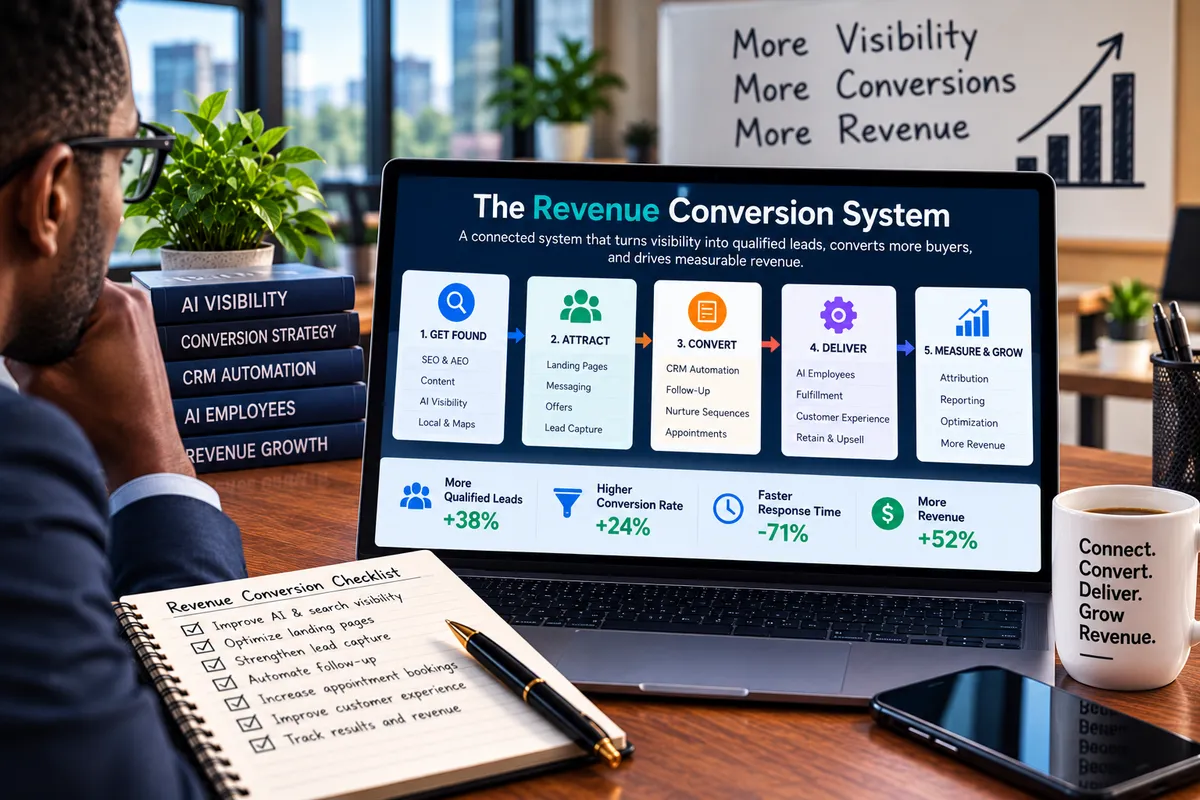
What Is a Revenue Conversion System?
A Revenue Conversion System is a coordinated set of processes and technologies designed to turn qualified customer interest into measurable business outcomes. It connects landing pages, inquiry capture, qualification, scheduling, sales follow-up, and transaction reporting. Its effectiveness depends on clear customer journeys, reliable information, defined responsibilities, and the ability to identify where opportunities are lost.
Why It Matters
Attracting potential customers is only one part of business growth.
A company may invest heavily in advertising and content while its sales process remains inconsistent.
Inquiries may arrive through different channels, employees may use different qualification criteria, and customer records may be incomplete.
A Revenue Conversion System creates a more organized process for moving qualified opportunities toward a purchase.
It also makes conversion problems easier to identify.
How It Works
Create relevant customer entry points
Landing pages and service information should match the customer's needs.
Capture inquiries consistently
Forms, calls, and supported messaging channels should connect to reliable intake processes.
Qualify opportunities
The business establishes criteria for determining customer fit and the appropriate next action.
Coordinate sales follow-up
CRM workflows, reminders, and staff assignments help maintain continuity.
Support appointments and proposals
The system records consultations, estimates, proposals, and other meaningful sales activities.
Track completed outcomes
Management measures which opportunities become paying customers.
Improve the conversion process
Reporting identifies where qualified opportunities stop progressing.
Example
Illustrative scenario.
A commercial landscaping company receives inquiries through its website and advertising campaigns.
Previously, inquiries were managed through separate employee inboxes.
The company introduces dedicated service pages, CRM intake, qualification rules, appointment scheduling, and sales-stage reporting.
Management can now identify how many inquiries progress to site visits, proposals, and completed contracts.
The system makes it easier to determine whether weak results originate from marketing quality or sales execution.
Common Problems or Mistakes
Treating the CRM as the entire system. Software cannot replace defined business processes.
Failing to connect marketing and sales. Acquisition data becomes less useful when it disappears after lead capture.
Overautomating customer interactions. Some decisions require human judgment.
Ignoring lead quality. More form submissions do not necessarily produce better commercial results.
Failing to track completed revenue. Pipeline growth should not be confused with realized sales.
InnoVisions Perspective
InnoVisions positions the Revenue Conversion System as a core part of the broader AI Revenue System.
Get Found creates discoverability.
Convert More establishes a reliable path from interest to opportunity.
Run Smarter coordinates workflows and business intelligence.
Measure Revenue evaluates completed outcomes.
The Revenue Conversion System connects these functions around the customer's buying journey.
Related Questions
How Do AI Revenue Systems Work?
How Do You Audit a Sales Funnel for Conversion Gaps?
How Does AI Lead Follow-Up Work?
CTA
Get Your AI Visibility & Revenue Leak Assessment
See how easily AI systems can understand and recommend your business—and what happens after the recommendation. Identify the biggest leaks between visibility, conversion, follow-up, and measurable revenue.
