How Do You Audit a Sales Funnel for Conversion Gaps?
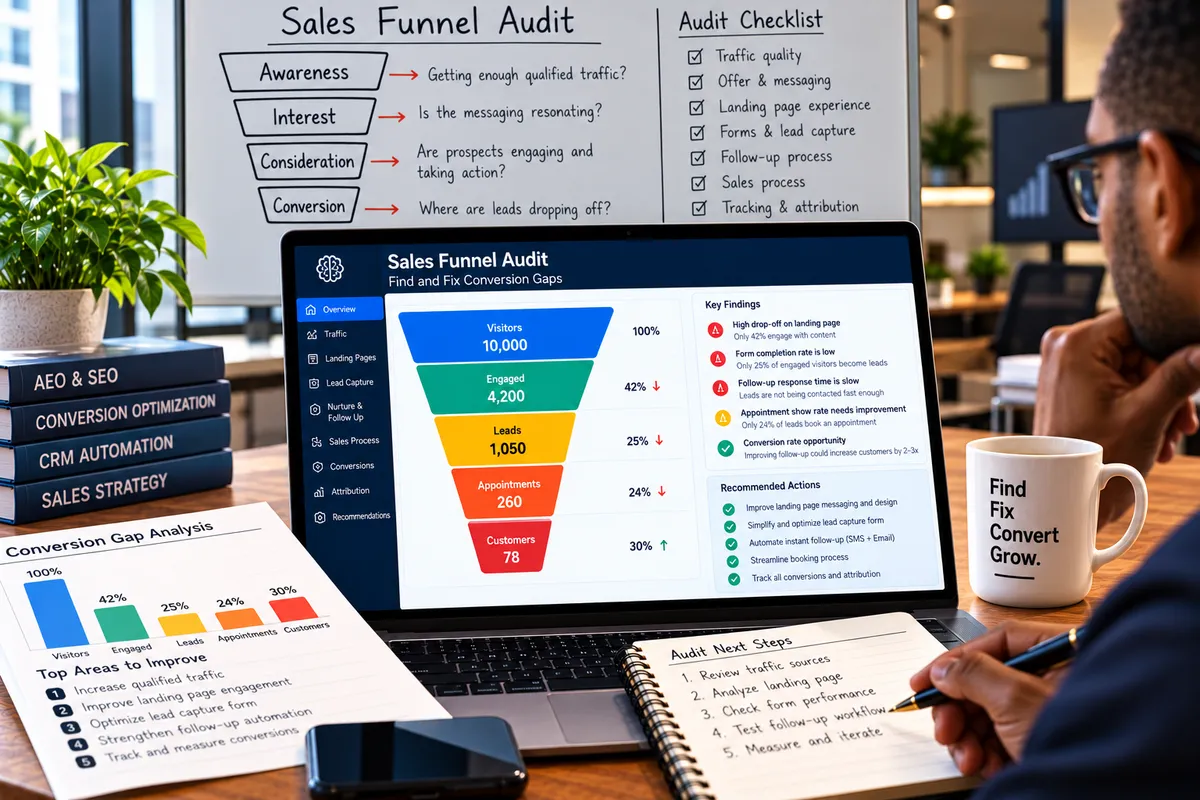
Audit a sales funnel for conversion gaps by mapping each stage of the customer journey, measuring how many qualified opportunities progress between stages, and investigating unusual losses. Review lead capture, response times, qualification, appointments, proposals, and completed sales. The objective is to identify preventable obstacles and prioritize corrections according to their likely effect on customer experience and revenue.
Why It Matters
Businesses often evaluate marketing performance through total inquiries.
But inquiry volume reveals little about what happens afterward.
A company might receive enough leads while losing opportunities because of slow responses, unsuitable qualification rules, missed appointments, or weak proposals.
A sales funnel audit separates these problems.
It helps management determine whether the next investment should involve marketing, website conversion, sales operations, or customer follow-up.
How It Works
Map the actual funnel
Document the stages customers pass through.
For a consulting business, these may include inquiry, contact, qualification, consultation, proposal, and completed sale.
Establish consistent stage definitions
Employees should agree on what qualifies as a contacted lead, qualified opportunity, or completed sale.
Without consistent definitions, reporting becomes unreliable.
Measure stage conversion rates
Calculate the proportion of opportunities progressing from one stage to the next.
For example:
\[ Stage\ Conversion\ Rate=\frac{Opportunities\ Advancing}{Opportunities\ Entering}\times100 \]
Use consistent reporting periods and appropriate opportunity cohorts.
Identify significant losses
Look for stages with unexpectedly low progression.
Compare performance across relevant lead sources, service categories, and teams.
Investigate the cause
Review CRM activity, customer feedback, scheduling records, and representative sales conversations.
Prioritize improvements
Estimate which correction could recover the greatest number of qualified opportunities at a reasonable cost.
Retest after changes
Measure whether the corrected process improves stage progression and completed sales.
Example
Illustrative scenario.
A consulting company records the following monthly funnel activity:
Stage | Opportunities |
|---|---|
Inquiries received | 200 |
Contacted | 150 |
Qualified | 90 |
Consultations completed | 45 |
Sales completed | 15 |
The company notices that only half of qualified opportunities complete a consultation.
Investigation reveals scheduling conflicts and inconsistent reminders.
The first improvement focuses on booking availability and appointment coordination rather than increasing advertising.
Common Problems or Mistakes
Treating every stage decline as a failure. Some prospects are legitimately unqualified.
Using inconsistent definitions. Teams may report different meanings for the same stage.
Ignoring time delays. Opportunities may need more than one reporting period to progress.
Optimizing for appointments instead of completed sales. Intermediate conversions should support commercial outcomes.
Changing several stages simultaneously. This makes it difficult to identify which correction mattered.
InnoVisions Perspective
InnoVisions uses funnel analysis to connect Get Found with Convert More and Measure Revenue.
The audit identifies where qualified interest stops progressing.
Automation may help address some bottlenecks, but the correct intervention depends on the evidence.
The objective is to improve the actual revenue process rather than simply generate more leads.
Related Questions
How Do You Find Revenue Leaks in Your Business?
How Does Website Conversion Optimization Increase Revenue?
What Is a Revenue Leak Scorecard?
How Do You Prioritize AI Revenue Improvements?
CTA
Get Your AI Visibility & Revenue Leak Assessment
See how easily AI systems can understand and recommend your business—and what happens after the recommendation. Identify the biggest leaks between visibility, conversion, follow-up, and measurable revenue.
