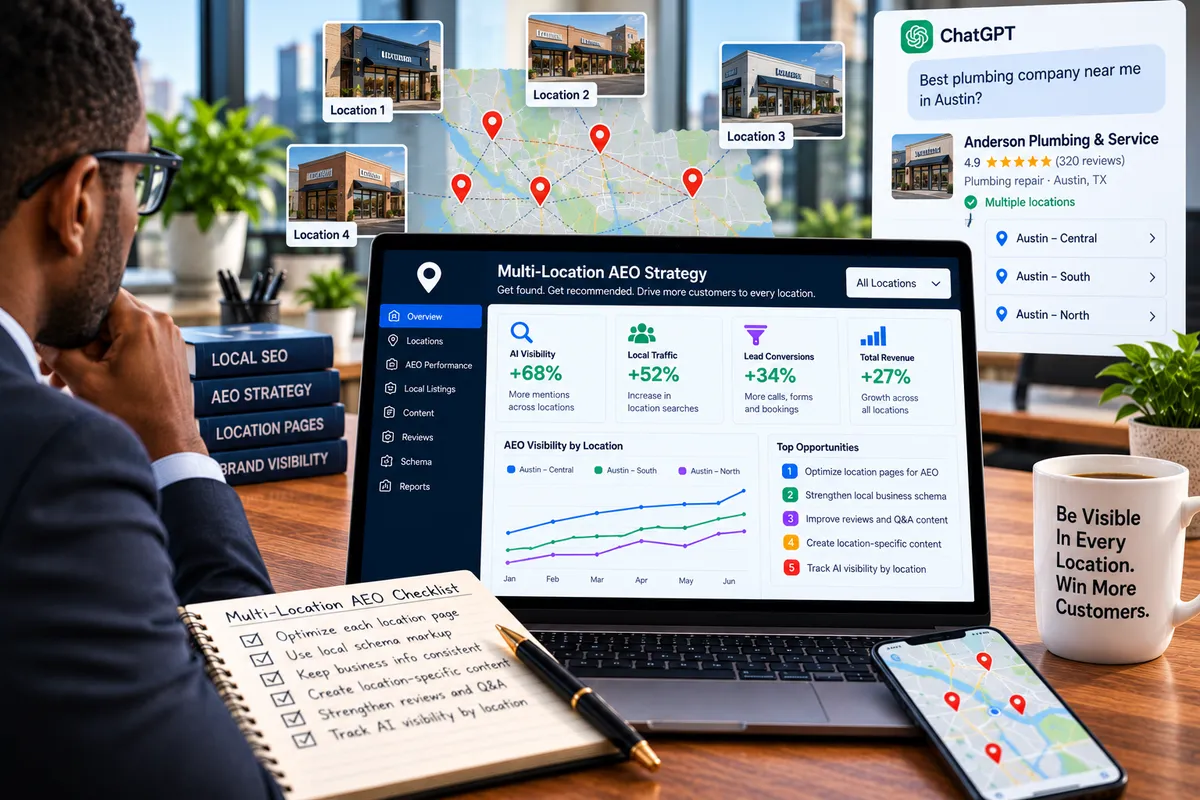
How Multi-Location Brands Can Improve AEO
Multi-location brands can improve AEO by maintaining accurate information for each location, publishing genuinely useful location-specific content, and answering the questions customers ask in different markets. Service availability, contact details, and geographic coverage should be consistent across relevant sources. Performance should be evaluated by location because brand-wide visibility can conceal significant differences between individual markets.
Why It Matters
A business operating across several cities faces a more complex discoverability problem than a single-location company.
An AI search experience may identify the parent brand while overlooking a specific branch.
It may also confuse service areas or attribute services offered at one location to another.
Customers need accurate local information to determine whether the business can meet their needs.
AEO therefore requires both brand consistency and location-specific clarity.
How It Works
Create a reliable location inventory
Document each location's approved name, address where applicable, contact details, service area, and available services.
Develop useful location pages
Each page should provide information relevant to customers in that market.
This may include local services, contact options, operating details, and genuinely location-specific information.
Avoid duplicating the same page across dozens of cities with only the location name changed.
Maintain consistent business identity
Connect each location clearly to the parent organization.
Use accurate naming conventions across the website and relevant business profiles.
Answer local customer questions
Identify questions specific to each service area.
A customer may ask whether a provider serves a particular neighborhood or offers a specific service at the nearest branch.
Improve technical accessibility
Use clear internal navigation and appropriate structured data where applicable.
Measure visibility by location
Test representative questions for each market.
Record mentions, citations, geographic accuracy, and relevant customer inquiries.
Example
Illustrative scenario.
A regional HVAC company operates in five cities.
Its website contains nearly identical location pages with little information about actual service coverage.
The company verifies each location's service area and updates the pages with accurate operational details.
It then tests local questions across relevant AI search experiences.
The objective is to improve geographic clarity and identify markets where discoverability remains weak.
Common Problems or Mistakes
Creating duplicate city pages. Thin location content may provide little customer value.
Publishing inaccurate service areas. Misleading information can create unsuitable inquiries.
Using only brand-wide reporting. Weak local performance may remain hidden.
Assuming one location's visibility represents every branch. AI responses may differ by geography.
Failing to maintain location records. Outdated contact details can disrupt customer conversion.
InnoVisions Perspective
InnoVisions connects multi-location AEO to the Get Found outcome of its AI Revenue System.
However, each location also needs appropriate landing pages, inquiry routing, and revenue reporting.
The broader objective is to understand which markets generate qualified opportunities and where visibility or conversion problems remain.
Related Questions
How Do You Optimize Service Pages for AI Search?
How Do You Measure AI Search Citation Visibility?
CTA
Get Your AI Visibility & Revenue Leak Assessment
See how easily AI systems can understand and recommend your business—and what happens after the recommendation. Identify the biggest leaks between visibility, conversion, follow-up, and measurable revenue.
