How CRM Automation Reduces Missed Leads
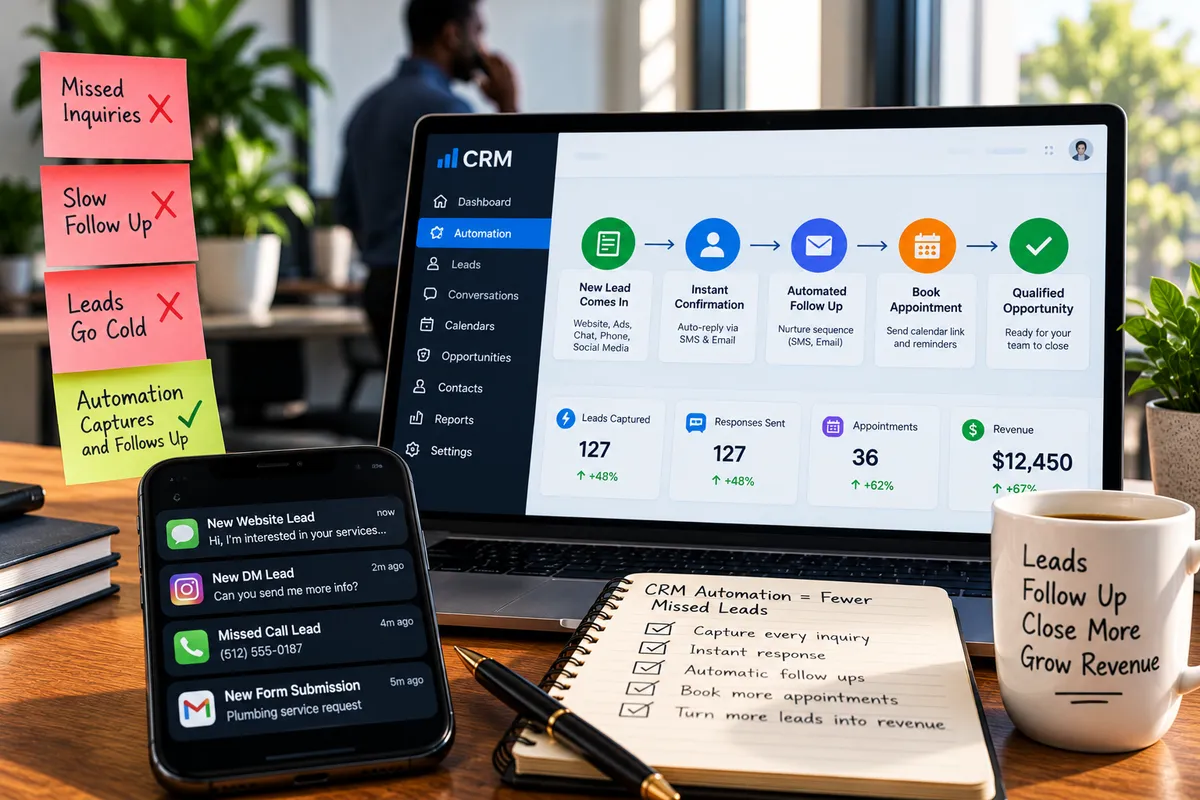
CRM automation can reduce missed leads by capturing inquiries from connected channels, creating customer records, assigning responsibility, and triggering appropriate follow-up tasks or notifications. It helps businesses identify inquiries that have not received attention and coordinate the next action. Effectiveness depends on reliable integrations, accurate records, staff accountability, and monitoring rather than automation alone.
Why It Matters
A company may generate inquiries through website forms, telephone calls, advertising campaigns, and social messaging.
When those inquiries arrive in disconnected inboxes, some may be overlooked.
Others may receive duplicate responses or remain unassigned.
CRM automation can establish a consistent process for handling incoming opportunities.
However, the business still needs employees or authorized systems to complete the required actions.
How It Works
Capture inquiries from approved channels
Connect website forms, supported communication channels, and other lead sources to the CRM.
Test whether inquiries are received correctly.
Create or update customer records
Use consistent contact fields and duplicate-handling rules.
A returning customer should not automatically become several unrelated contacts.
Assign ownership
Determine which employee or team is responsible for the inquiry.
Routing may depend on service type, location, availability, or other legitimate business criteria.
Trigger appropriate acknowledgment
An approved workflow may confirm receipt and explain what happens next.
Communication permissions and customer preferences must be respected.
Create follow-up tasks
The CRM should identify the next required action and responsible owner.
Monitor unanswered inquiries
Use task status, activity records, and reporting to identify opportunities without documented follow-up.
Measure downstream outcomes
Track contact rates, qualified appointments, sales opportunities, and completed sales.
Example
Illustrative scenario.
A plumbing company receives service requests through its website and telephone system.
Previously, employees manually reviewed messages and entered inquiries into a spreadsheet.
The company introduces CRM workflows that create contact records, route requests, and notify the responsible staff member.
A dashboard identifies inquiries without documented follow-up.
Management can now investigate specific missed opportunities rather than relying on general impressions.
Common Problems or Mistakes
Assuming a notification guarantees a response. Someone must remain accountable for the inquiry.
Creating duplicate customer records. Fragmented histories can lead to inconsistent follow-up.
Using incorrect routing rules. Leads may be assigned to unavailable employees.
Ignoring failed integrations. A disconnected form can silently stop creating records.
Measuring workflow executions instead of sales outcomes. Automation activity does not equal revenue.
InnoVisions Perspective
InnoVisions connects CRM automation to Convert More and Run Smarter.
Lead capture creates the opportunity, but reliable routing and follow-up determine whether the business responds effectively.
The AI Revenue System then connects those activities to Measure Revenue, allowing management to evaluate whether fewer missed inquiries result in more qualified opportunities and sales.
Related Questions
How Does AI Lead Follow-Up Work?
How Do You Calculate Lead Response Time?
How Do You Reduce Missed Calls With CRM Automation?
How Do You Find Revenue Leaks in Your Business?
CTA
Get Your AI Visibility & Revenue Leak Assessment
See how easily AI systems can understand and recommend your business—and what happens after the recommendation. Identify the biggest leaks between visibility, conversion, follow-up, and measurable revenue.
